
We had a 2 hour flight that morning headed to Salta. We picked up our rental car and drove a little over 3 hours further north to the small town of Purmamarca. They are famous for the seven color hills that are around the town.
We took the scenic Route 9 on the way to Purmamarca. It is really a pretty drive and it’s interesting how the landscape changes.


Had lunch at a little hole in the wall in Jujuy. We found it from it’s chalkboard sign along the road. Interesting place and the food was pretty good.


This time we had a small holiday home within walking distance to the town center. Walked to a local shop to pickup stuff for dinner.

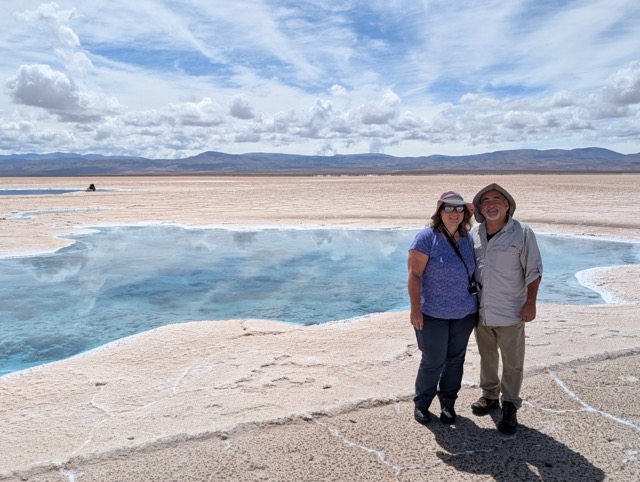
The next morning we headed out to the Salina’s Grandes or the Great Salt Flats. Will did not like the twisty mountain road (Route 52) to get to the flats, but it seems the big trucks do not mind at all. There’s a number of trucks bringing merchandise from the Chilean coast to mostly Paraguay. The road reaches a high point of 4,170 meters (13,681 feet). We were both feeling the altitude a little bit.


There are two tourist areas there and we just stopped at the first one we saw. The area we were at, you follow your guide in your vehicle. He leads you out to the salt flat on his motorcycle.


The salt flats were created from an ancient lake. Since the water had no where to go; it dried up and left the minerals behind. The salt is replenished from the rain and minerals from the surrounding volcanic mountain range. They have been harvesting salt from the flats for hundreds of years. The best salt is used for individual consumption. They also mine salt for industrial purposes and salt blocks for animals as well as building blocks for houses in the area.


Our guide Julio was very nice. He slowed down his Spanish explanations so Will could then translate for me. This tourism industry was created about 15 years ago. It provides Jobs for the indigenous people and has encouraged them to stay in the area.
They really do have a lot of fun out there taking some interesting photos using perspectives. And yes they charged us more for being foreigners, but at least we thought we were helping the community.
After our little tour, we drove a little further into the salt flats. There is another tourist area, which looks to be where the tourist groups go. We saw some wild vucunas while we were up there. We hadn’t seen any since we were in Peru.
We came back and had a little siesta and then went to walk the Paseo de los Colorados trail. You can either start from where the overlook is or from the cemetery. We think starting from the overlook had a more gradual incline.


The following morning we headed out to the Pucara de Tilcara. This is an archaeological site of a pre-Hispanic settlement. We arrived and went to get tickets only to find out they take cash only. And of course, we didn’t have enough cash. They told us we could probably find a money exchange in the center of town. After driving through the town on the way to the ruins, we opted to walk back to the center as we didn’t think we’d find a place to park. Finally found the exchange and also a taxi to take us back to the ruins.


We explored the ruins. Pucara is a Quechuan word that means fort. People lived here from the first millennium until the Spanish came through in the 16th Century. It was interesting as they also discussed some of the errors made in the archeology practices of the site. There was a monument built to honor the first archeologists on the site. In the building process they demolished several of the houses, work rooms and a main square.


We couldn’t find parking near the center of Tilcara, so we drove further up the road to Humahuaca. This is the place where you hire a driver to take you up to view the mountains of 14 colors. We opted not to do that, but went to grab lunch instead. Found a spot serving Locro, which I had been wanting to try. It’s a stew that has beans, cornmeal, squash and meat. It was very tasty. We were tired from being out in the hot sun and drove back to our place in Purmamarca.


The next morning, we got on the road and headed back to Salta. We were almost immediately stopped at one of the police checkpoints. Will passed the breathalyzer and we were back on our way. These police checkpoints are very common throughout Argentina. Sometimes you are required to stop and sometimes they just wave you through. This time we did not do the scenic Route 9 back to Salta, but did the highway. The highway actually takes longer, but you don’t have all the twists and turns to deal with.